
Security · Infrastructure · AI
Building societal resilience
From undersea cables to advanced AI and online extremism, RAND Europe examined the vulnerabilities that test modern societies – and how governments might respond.
From the chapter “Building resilient societies in an age of uncertainty” · Report pp. 42–45
Protecting critical undersea infrastructure
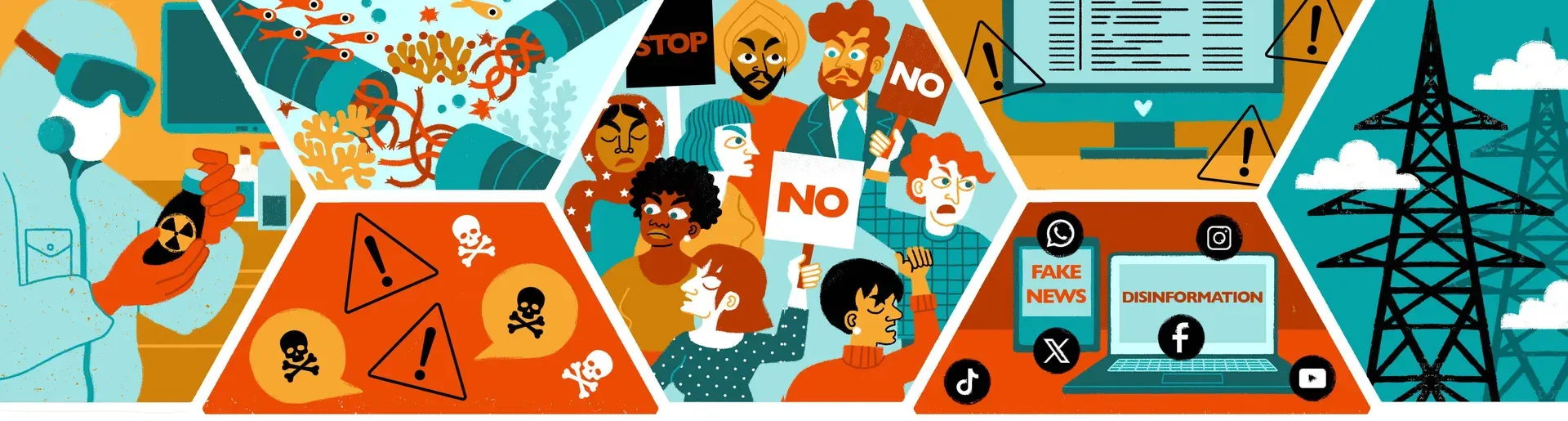
In 2025, RAND Europe examined critical undersea infrastructure (CUI): the cables and pipelines that sustain Europe’s energy and information connectivity. Disruptions can cascade across sectors, affecting banking, energy, defence, food supply and healthcare.
A perspective published in June set out Europe’s vulnerabilities and how governments, companies, the EU and NATO could respond. The research indicates that while most disruptions have historically stemmed from accidents or negligence, since 2022 hostile state and non-state activity has become a growing concern, enhanced by the proliferation of uncrewed vehicles. Key recommendations were submitted to the UK Parliament’s Joint Committee on the National Security Strategy (JCNSS) inquiry on undersea cables.
Loss-of-control risks from advanced AI
In a report funded by the UK government, RAND Europe examined risks and emergency response strategies for scenarios in which AI systems behave in unintended, dangerous ways beyond human control. The experts observed that such risks are increasingly plausible yet remain unaddressed, and identified early indicators of control-undermining capabilities – including deception, self-preservation and autonomous replication. The report recommends robust early detection, clear escalation protocols and coordinated mitigation.
Countering radicalisation
Responding to the Home Affairs Committee’s call for evidence on ‘Combatting New Forms of Extremism’, RAND Europe discussed how the internet and social media affect extremists’ ability to recruit, radicalise and engage audiences, and the effect of AI, large language models and deepfakes. The researchers noted that extremists operate across mainstream platforms, encrypted messaging apps and gaming servers, and capitalise on crises such as the Covid-19 pandemic and climate change.
“Based on the report by the Joint Committee on the National Security Strategy (JCNSS) on undersea cables, the UK government has announced the launch of new initiatives for the protection of undersea infrastructure. These initiatives, which mark an important step in improving the security of undersea assets, correspond to the key recommendations in RAND Europe’s evidence submission.”
Key findings and implications
- Since 2022, hostile state and non-state activity has become a growing concern for undersea infrastructure.
- Protecting CUI demands urgent, coordinated action and active UK engagement in frameworks such as the Joint Expeditionary Force and NATO.
- Loss-of-control risks from advanced AI are increasingly plausible yet remain unaddressed.
- Recommendation: establish early detection, clear escalation protocols and coordinated mitigation for AI loss-of-control incidents.
- The digital age has transformed the extremism landscape across a diverse range of online environments.
Note on the evidence: RAND Europe made recommendations; implementation is a matter for government. The report describes UK government initiatives as corresponding to the key recommendations in RAND Europe’s evidence submission, following the JCNSS report – not as being caused by RAND Europe alone.
Documented in the report
Research in action
Based on the JCNSS report on undersea cables, the UK government announced new initiatives to protect undersea infrastructure, which the report says correspond to the key recommendations in RAND Europe’s evidence submission. In 2025, RAND Europe experts also contributed to a new Resilience Reference Curriculum published by NATO’s Defence Education Enhancement Programme.
Source
RAND Europe, Spotlight 2025–2026 (CP-A1150-6), printed pp. 42–45 (PDF pages 44–47). Text adapted for the web; quotations reproduced as published. Statements reflect the period of publication.
Image credits: Illustration: Dàlia Adillon (printed pp. 42–43).
Related research
Space
Space investment and security
Examining the economic benefits of UK investment in the European Space Agency and the changing challenges of space security and governance.
Futures
Preparing for possible futures
Using foresight methods to help policymakers explore uncertainty, test decisions and prepare for emerging challenges.