
Futures · Security · Young people
Preparing for possible futures
RAND Europe’s Centre for Futures and Foresight Studies helps decision makers explore plausible futures – not predict them – and test whether today’s policies would hold up.
From the chapter “Anticipating change through futures and foresight” · Report pp. 46–49

Navigating radical uncertainty
The UK government’s 2025 National Security Strategy describes an ‘era of radical uncertainty’. RAND Europe’s Centre for Futures and Foresight Studies (CFFS) uses a range of methods to help governments and wider society navigate possible futures: horizon scanning, trends analysis and systems mapping; anticipating scenarios and their impacts; building plausible, evidence-driven pictures of different futures; and exploring options for action.
These methods can help clients stress-test policy decisions, prepare for a range of scenarios and examine questions from multiple perspectives. They describe what could happen, not what will.
Trends in Focus
The 2025 Trends in Focus report examines forces that RAND Europe researchers believe could have a profound impact on UK and European society over the next five years, yet risk being underestimated or ignored. The team combined a literature review of around two dozen open-source trend publications with internal crowdsourcing, then brought together 15 senior experts from across RAND Europe’s four research groups to score each trend by likely impact and how overlooked it is.
The result is nine trends grouped into three themes. Under balancing security and society, the researchers caution against viewing defence spending as a ‘silver bullet’ for prosperity and highlight closer European collaboration. On disconnected youth, they point to limited social mobility, rising relative child poverty and declining adolescent mental health, and call for further research. On resilience, they note that governments’ short-term focus can lead them to underestimate the benefits of prevention.
“The Centre for Futures and Foresight Studies (CFFS) uses different future and foresight methods to support clients and partners across different topic areas, such as defence, transport and emerging technologies. Using future and foresight methods can help clients explore a range of future scenarios to enhance preparedness and early adaptation, stress-test and validate policy decisions to ensure they are robust in the face of uncertainty, and explore policy questions from multiple perspectives to uncover cognitive biases.”
Key findings and implications
- Foresight methods can help stress-test policy decisions against a range of plausible futures.
- European defence spending will likely continue to increase, which the research indicates will trigger difficult economic and societal decisions.
- Challenges facing young people are interconnected and could weaken the resilience of society and the economy.
- Preventing crises is almost always less expensive and more effective than responding to them, though its benefits are less visible.
Documented in the report
The inaugural Foresight Forum
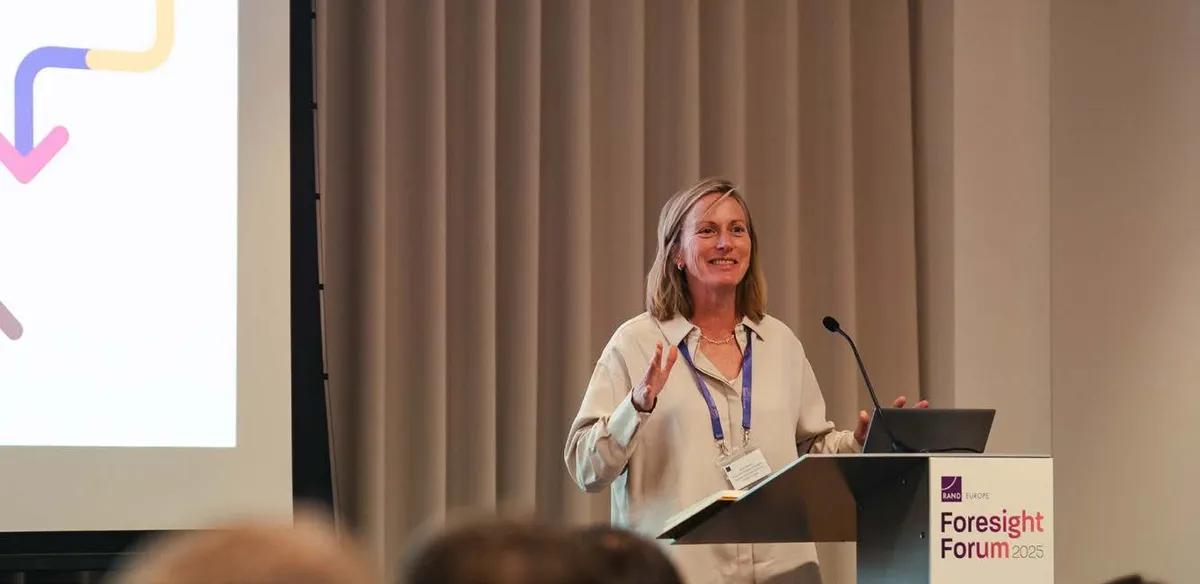
In October 2025, RAND Europe hosted its inaugural Foresight Forum, bringing together policymakers, industry leaders and academics. Attendees took part in a new war game on the application of AI in healthcare, used RAND-developed crowd-sourced forecasting tools and ran a three horizons workshop on balancing security and other public spending. The latest Trends in Focus report was launched at the event.
Source
RAND Europe, Spotlight 2025–2026 (CP-A1150-6), printed pp. 46–49 (PDF pages 48–51). Text adapted for the web; quotations reproduced as published. Statements reflect the period of publication.
Image credits: Illustration: Dàlia Adillon (printed p. 46); Photograph: William Blakesley-Herbert (printed p. 49).
Related research
Security
Building societal resilience
Research on protecting critical infrastructure, preparing for advanced AI risks and responding to threats to social cohesion.
Education
Education’s role in preventing youth violence
Understanding how school experiences, trusted relationships and education policy can help protect young people from violence.